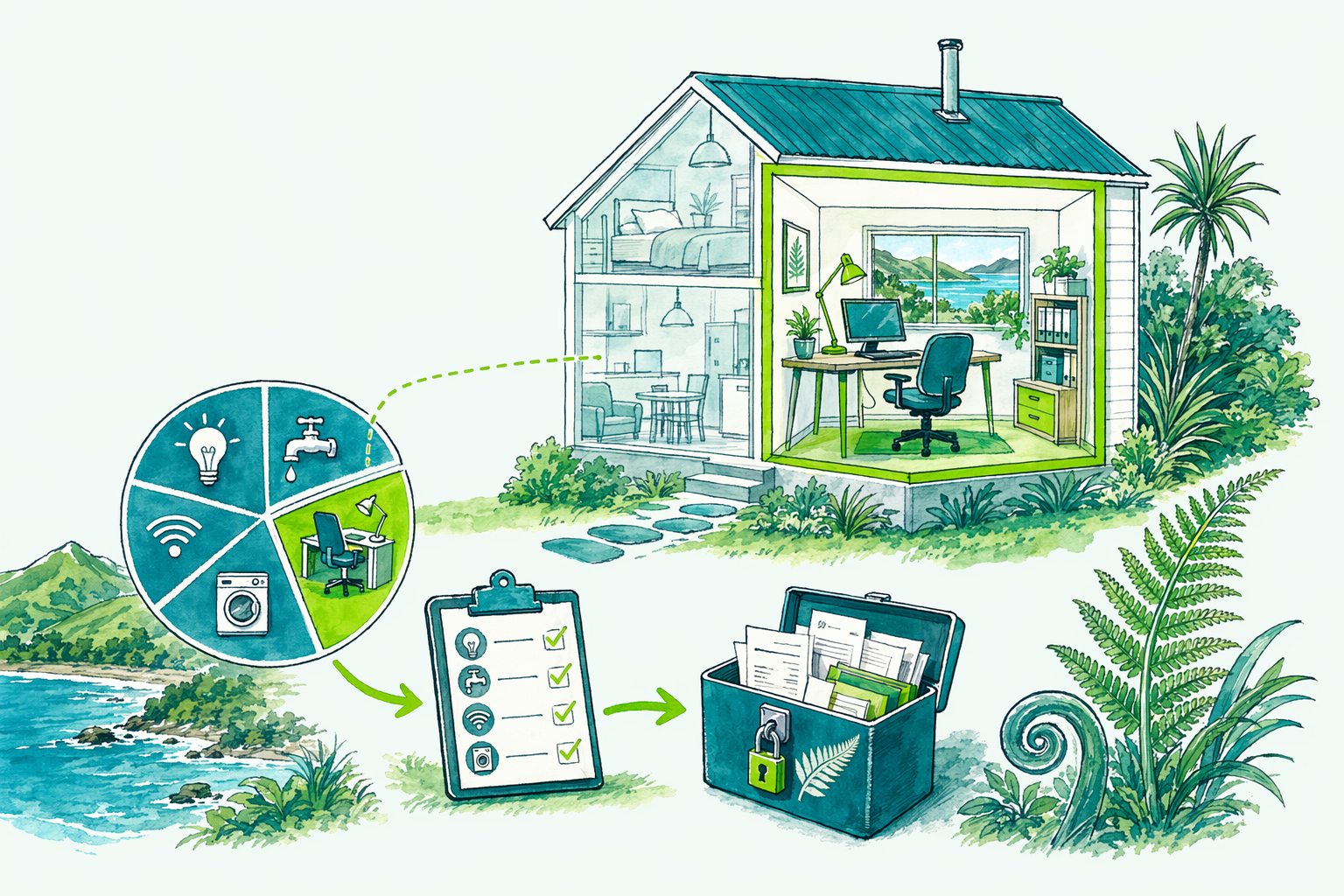
If you run your business from home, you can claim a fair share of your household running costs against your income. The trick is working out a defensible proportion and keeping the records to back it up.
Quick answer
When you use part of your home for business, you can claim a proportion of the running costs that relate to that use, things like power, rates, insurance, mortgage interest or rent, and internet. The usual basis is the area your business uses as a percentage of the whole home. If your home office is 12 m² in a 120 m² house, that is 10%, so you can claim 10% of the shared running costs.
IRD also publishes a square-metre rate option each year that bundles most utility-type costs into a set dollar amount per square metre, which you can use instead of working out actual utility percentages. Either way, you only claim the business share, never the full household bill.
The detail, in plain English
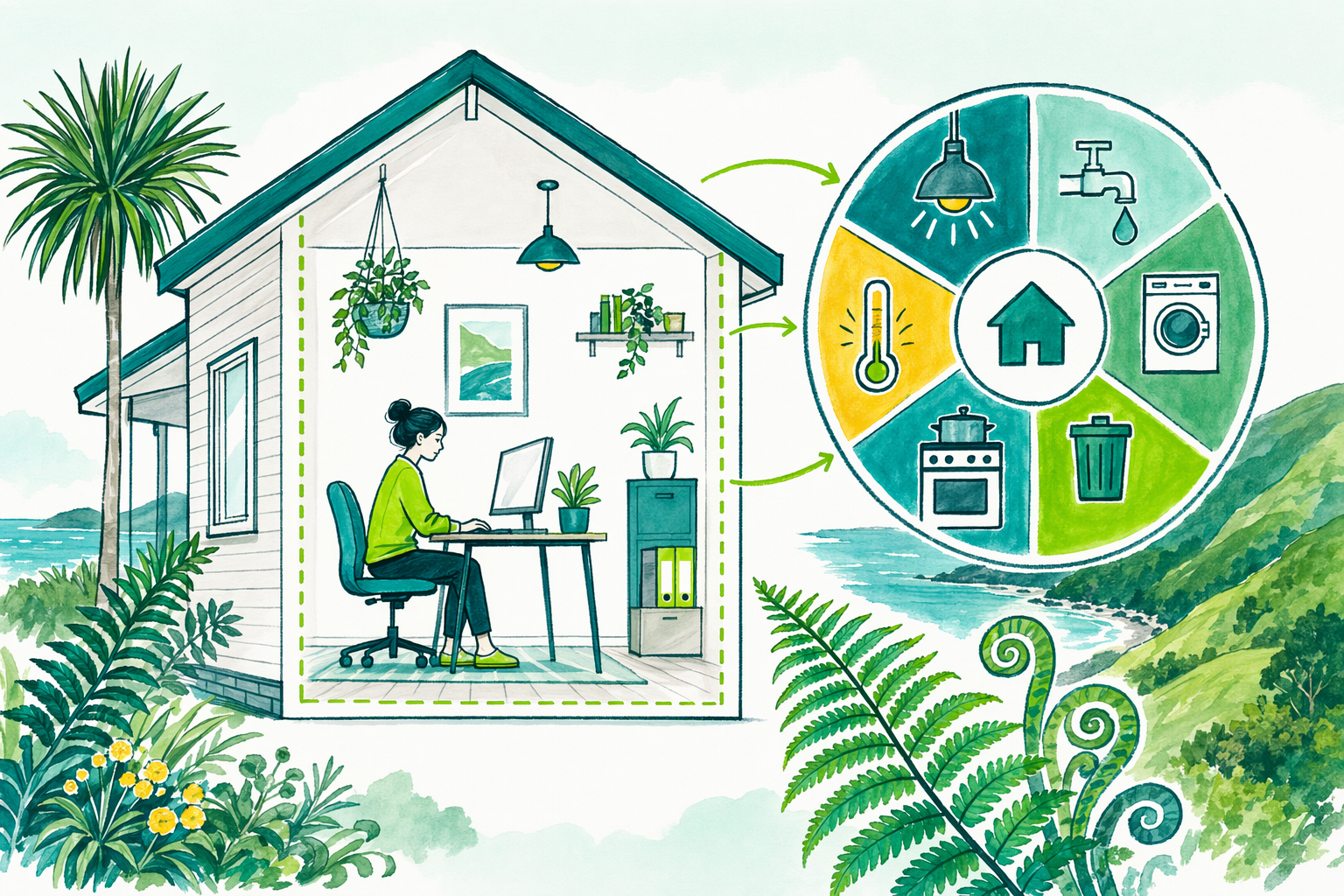
There are two common ways to work out the claim, and you pick whichever suits your records.
1. The actual-cost (floor-area) method. You measure the area used for business, divide it by the total floor area, and apply that percentage to your household running costs. This works well when you have a dedicated room and keep your power and insurance bills.
2. The square-metre rate method. IRD sets a rate per square metre that covers most utility costs in one figure, so you do not have to itemise power, gas and the like. You still add the business-use share of premises costs such as rates, rent, mortgage interest and building insurance separately, because those are not in the bundled rate.
Whichever method you use, these are the cost types people commonly apportion:
| Cost | Claimable share |
|---|---|
| Power, gas, internet | Business-use % |
| Rates & house insurance | Business-use % |
| Mortgage interest or rent | Business-use % |
| Repairs to the work area | Often fully claimable |
| Repairs to the whole house | Business-use % |
Note that you claim mortgage interest, not the principal repayments, and only the business proportion.
A simple example
Mere runs a consulting business from a spare room. The room is 15 m² and the house is 150 m², so her business-use percentage is 10%.
Over the year her relevant household costs are: power $2,400, rates $3,000, house insurance $1,400, and mortgage interest $14,000. Applying 10%:
- Power: $240
- Rates: $300
- Insurance: $140
- Mortgage interest: $1,400
That is a $2,080 deduction against her business income for the year, simply for using a room she already had. Keeping the bills and a note of the measurement is what makes the claim stand up.
Common mistakes to avoid
- Claiming the whole bill. Only the business-use proportion is deductible, not the full household cost.
- Claiming mortgage principal. Only the interest portion can be apportioned, never the capital repayment.
- Overstating the area. A room used part-time for business should reflect that, not be claimed as if it were 100% business space.
- Keeping no records. If IRD asks, you need the measurements and the bills. A guessed percentage with no backup is the first thing that gets adjusted.
- Forgetting GST. If you are GST-registered, the GST treatment of these costs needs handling consistently with your income-tax claim.
Where this fits in your return
For a sole trader, the use-of-home claim reduces your business profit on your IR3, which lowers the income you pay tax on and can affect whether you move into provisional tax. For a company, the same logic applies through the company's accounts and IR4, often handled as a reimbursement from the company to the home-owner. Because it touches both income tax and, where relevant, GST, it is worth getting the method consistent year to year.
How Fernway can help
We will work out the right method for your situation, calculate a defensible business-use percentage, and make sure the claim is captured correctly in your accounts and return, with records that would satisfy IRD. It is a small line item that adds up year after year.
This is general information only, not personalised tax advice. Your situation may differ, so book a free 20-minute review and we will set your home-office claim up properly.
In plain English: measure the space you use for work, claim that percentage of your running costs (interest not principal), keep the bills, and the deduction looks after itself.
This is general information, not personalised tax advice.See our full disclaimer.