
When you register for GST you choose an accounting basis, and that choice quietly shapes your cashflow. Here is how the invoice basis and the payments (cash) basis compare in New Zealand, who can use each, and which keeps more money in your account.
The two options at a glance
The GST basis decides when a sale or purchase counts for GST, not how much. Both arrive at the same total over time; the difference is timing, and timing is cashflow.
| Invoice basis | Payments (cash) basis | |
|---|---|---|
| GST counts when | You issue or receive an invoice | Money actually changes hands |
| Effect on cashflow | You may owe GST before you are paid | You owe GST only once paid |
| Best suited to | Businesses paid promptly, or larger turnover | Smaller businesses, slower-paying customers |
On the invoice basis, the GST clock starts the moment you raise an invoice, even if the customer pays in 60 days. On the payments basis, GST is only counted when cash moves, which keeps the timing aligned with your bank account.
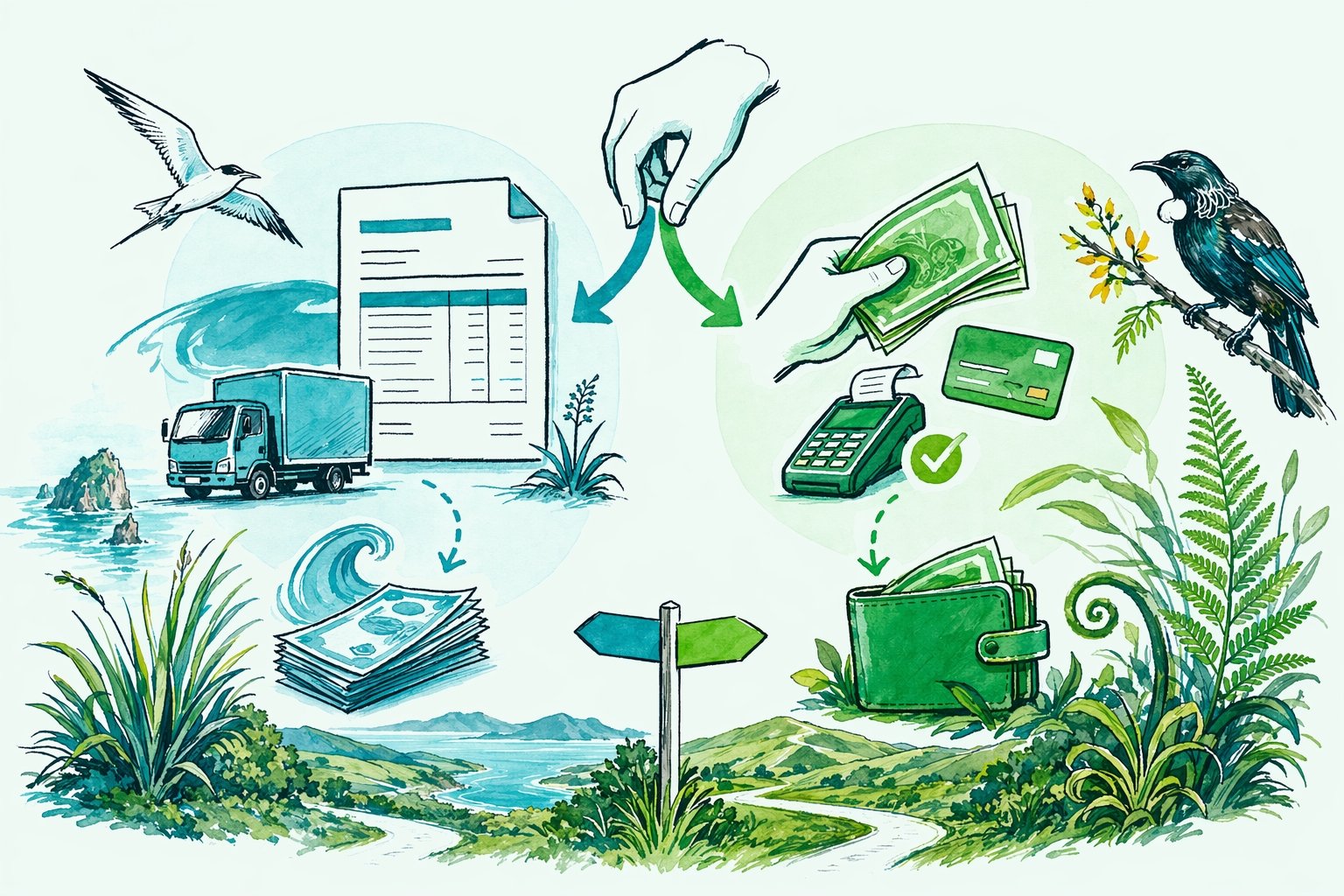
Tax treatment compared
The GST rate is 15% either way, and across a full year the total GST you pay or reclaim is the same. What changes is the period each transaction lands in.
- Invoice basis: you account for GST on sales when you invoice, and claim GST on purchases when you are invoiced, regardless of payment dates. This can mean paying GST to IRD on income you have not yet collected.
- Payments basis: you account for GST only when you actually receive or pay money. Your GST return tracks your bank, not your invoice book.
For a business with long debtor days, slow-paying clients, the payments basis can be noticeably kinder, because you are not funding GST out of pocket while you wait to be paid.
A simple example makes the timing concrete. Say you invoice a client $11,500 (including $1,500 of GST) in March, and they pay in May. On the invoice basis, that $1,500 of GST falls into your March return, due before the money arrives. On the payments basis, it falls into your May period, after you have been paid. Same GST, very different effect on your bank account in the meantime.
Cost and cashflow
Cashflow is the whole point of this decision.
- Payments basis tends to protect cashflow: GST leaves your account only after the customer's money has arrived.
- Invoice basis can squeeze cashflow if customers are slow, because GST can fall due before you have collected it, though you also claim GST on your purchases sooner.
There is no extra tax cost to either, it is purely a question of timing and which one keeps your bank balance healthier. For many small New Zealand businesses, especially those that invoice and wait, the payments basis is the more comfortable fit.
Risk and admin
Eligibility and admin differ between the two.
- Eligibility: the payments basis is generally available to smaller businesses below a turnover ceiling. Larger businesses are typically required to use the invoice basis. There is also a hybrid basis for specific situations.
- Admin: the payments basis is often simpler day-to-day because it follows your bank statement. The invoice basis requires you to track debtors and creditors, what you are owed and what you owe, to get the timing right.
- Switching: you can change basis, but it needs to be done cleanly so transactions are not counted twice or missed in the changeover period.
Software handles either basis without fuss once it is set up correctly, so the admin gap narrows considerably if you are using accounting software rather than a spreadsheet.
Which suits which owner
As a general guide:
- Payments basis suits smaller businesses, those with slow-paying customers, and anyone who wants their GST obligations to track their actual bank balance.
- Invoice basis suits businesses that are paid promptly, those that make large purchases and want to claim the input GST sooner, and larger turnovers that are required to use it.
If your customers pay on time and you buy a lot on credit, the invoice basis can actually help. If you invoice and then wait, the payments basis usually keeps you more comfortable. It comes down to the rhythm of your particular cashflow.
One practical tip: think about your typical payment terms. If you mostly take payment on the spot, retail, hospitality, trades paid on completion, the two bases behave almost identically, so simplicity and eligibility decide it. If you invoice and routinely wait weeks to be paid, the payments basis is usually the kinder choice for your cashflow.
Talk it through with us
Choosing a basis is one of those small decisions that quietly affects your bank balance every quarter. We will look at how you get paid, what you buy, and your turnover, then recommend the basis that suits your cashflow, and set it up correctly so the changeover is clean.
Book a free review and we will work out which basis fits, in plain English.
This is general information only, current at the time of writing, and not personalised tax advice. Your situation may differ. Confirm the detail with us or check ird.govt.nz before you act.
In plain English: the payments basis counts GST when money moves and usually protects cashflow for smaller, slower-paid businesses; the invoice basis counts it when you invoice and suits promptly-paid or larger operations.
This is general information, not personalised tax advice.See our full disclaimer.