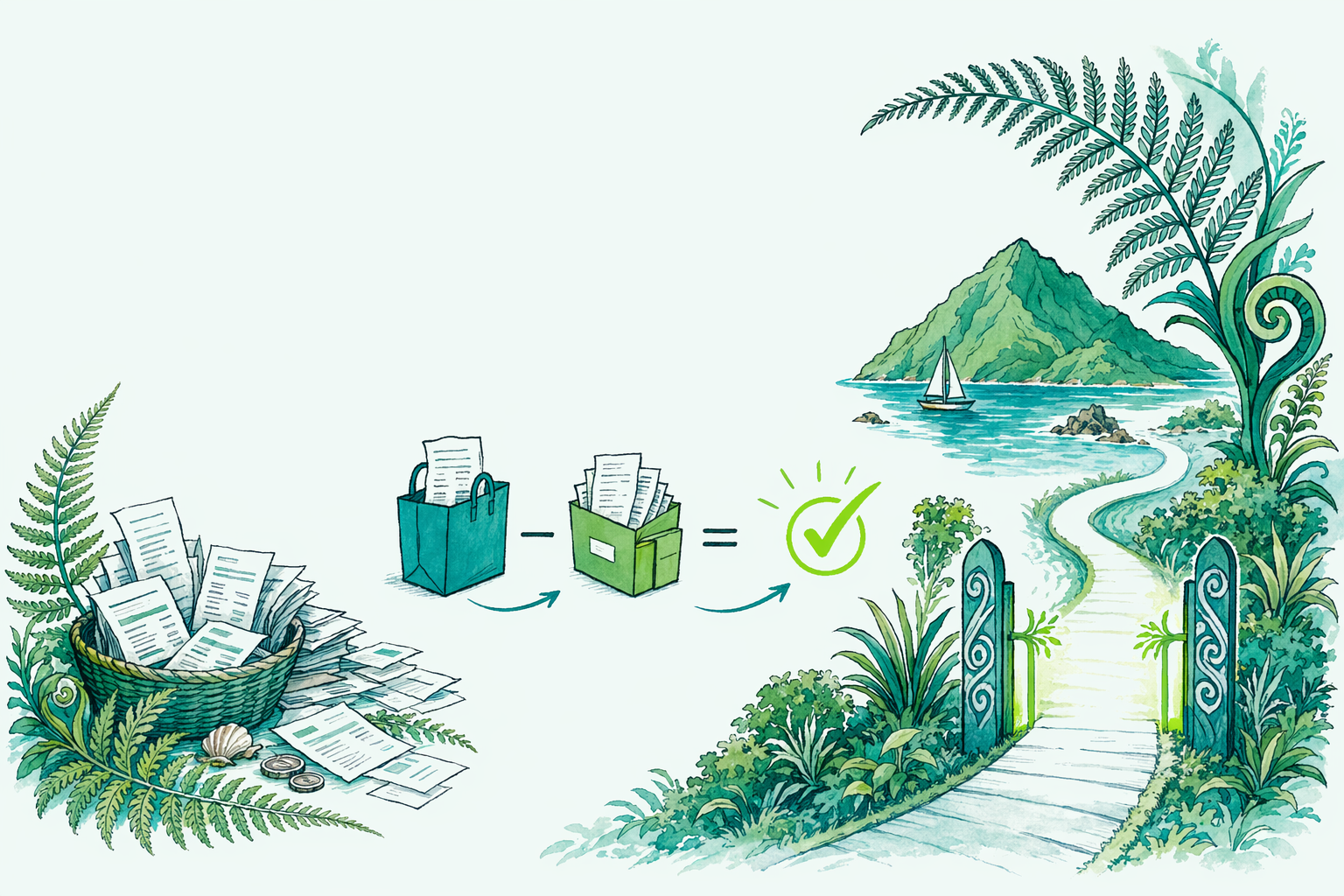
Filing a GST return is mostly arithmetic once your records are tidy. Knowing your basis, your filing frequency, and what counts is what makes it a five-minute job instead of a stressful afternoon.
Quick answer
A GST return reports the GST you collected on sales (output tax) and the GST you paid on business purchases (input tax). You file it through myIR, and you either pay IRD the difference or receive a refund. GST in New Zealand is 15%.
The mechanics come down to three choices you make when you register: your accounting basis (payments, invoice, or hybrid), your filing frequency (monthly, two-monthly, or six-monthly), and good record-keeping in between. With those settled, each return is just adding up two numbers and subtracting one from the other.
The detail, in plain English
Step 1: know your basis. The payments basis counts GST when money actually changes hands, which suits cash-flow-sensitive small businesses. The invoice basis counts GST when you issue or receive an invoice, even if it has not been paid yet. The hybrid basis mixes the two. Your basis decides which transactions go into this period's return.
Step 2: know your frequency.
| Frequency | Typically suits |
|---|---|
| Monthly | Larger turnover, or regular refund positions |
| Two-monthly | The common default for small businesses |
| Six-monthly | Smaller businesses under the turnover limit |
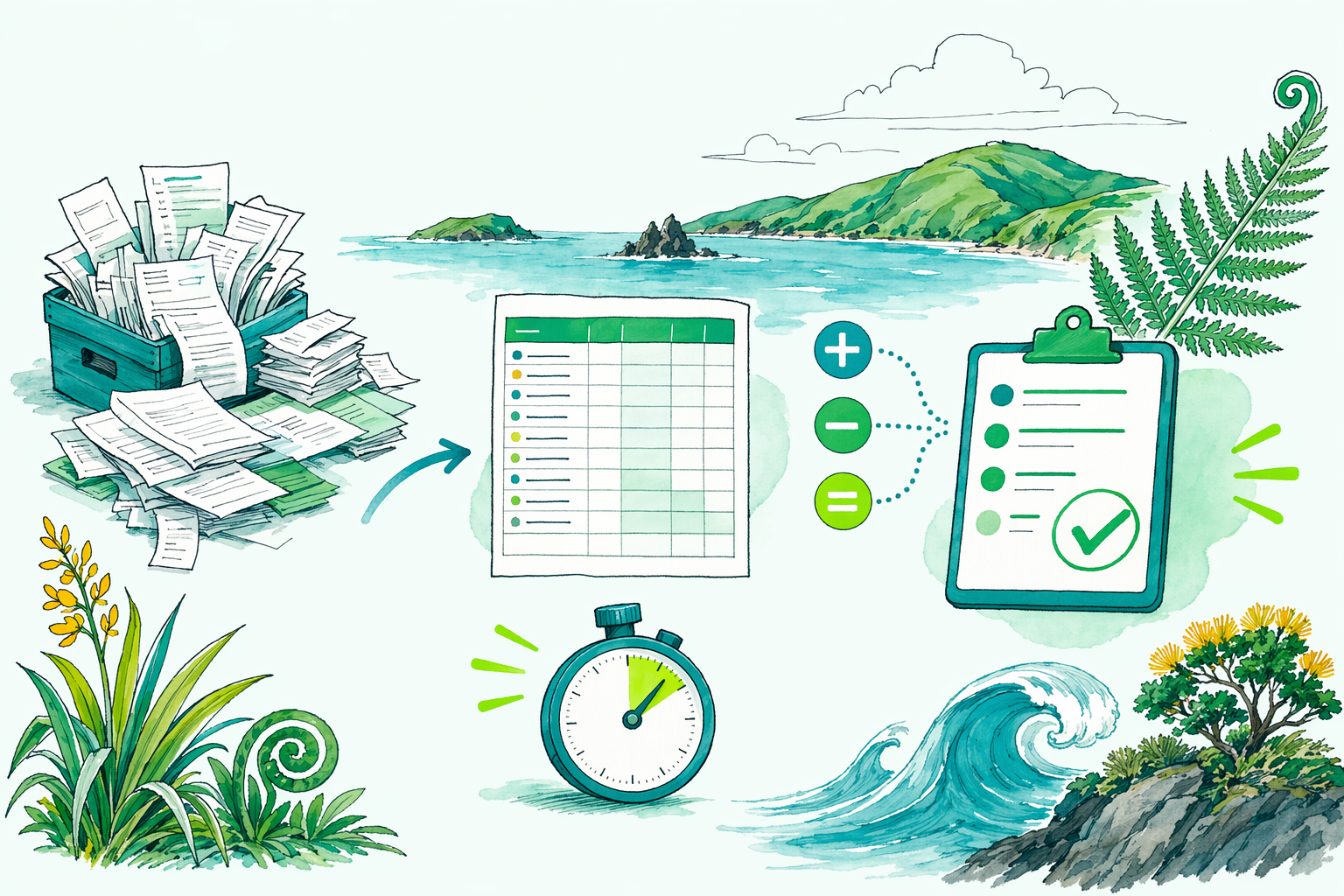
Step 3: total your figures. Add up the GST on your sales (output tax) and the GST on your business expenses (input tax). The return wants your total sales and income, the GST on them, your total purchases, and the GST on those.
Step 4: work out the result. Output tax minus input tax is what you pay; if input tax is larger, you are due a refund.
Step 5: file and pay by the due date. The return and any payment are generally due on the 28th of the month after the period ends (with shifted dates around year-end and Christmas). Good accounting software calculates most of this from your coded transactions.
A simple example
Tane runs a two-monthly, payments-basis GST registration. For the period he made $46,000 of sales (GST-inclusive) and spent $11,500 (GST-inclusive) on business costs.
- GST on sales (output tax): $46,000 ÷ 23 × 3 = $6,000
- GST on purchases (input tax): $11,500 ÷ 23 × 3 = $1,500
- GST to pay IRD: $6,000 − $1,500 = $4,500
Because GST is 15%, the GST portion of a GST-inclusive figure is found by dividing by 23 and multiplying by 3. Tane files the return showing those numbers and pays $4,500 by the 28th. Had his purchases been larger than his sales, the same arithmetic would have produced a refund instead.
Common mistakes to avoid
- Claiming GST on things that have none. Bank fees, interest, wages, and most residential rent do not carry GST, so do not claim input tax on them.
- Claiming the full cost of mixed-use items. For something used partly privately, only the business-use share of the GST is claimable.
- Mixing up your basis. On a payments basis you cannot claim GST on a bill you have not yet paid; on an invoice basis you can.
- Missing the 28th. Late returns and payments draw penalties and use-of-money interest.
- No tax invoice for larger purchases. Above the low-value threshold you need a valid tax invoice to support the claim.
Where this fits in your return
GST is separate from your income-tax return but feeds into it: your business figures should be recorded GST-exclusive for income tax once you are registered, so the GST does not get double-counted. Keeping your GST coding clean in Xero or similar software means your IR3 or IR4 at year-end largely falls out of the same tidy records. GST and provisional tax are also the two payments that catch growing businesses off guard, so it pays to budget for both.
How Fernway can help
We can set your basis and frequency to suit your cash flow, configure your software so returns almost prepare themselves, file your GST on time, and review your coding so you are not over- or under-claiming. If GST has been a recurring scramble, we will turn it into a routine.
This is general information only, not personalised tax advice. Your situation may differ, so book a free 20-minute review and we will take GST off your plate.
In plain English: pick a basis and a frequency, total the GST on your sales and your purchases, pay or claim the difference by the 28th, and let good software do the maths.
This is general information, not personalised tax advice.See our full disclaimer.