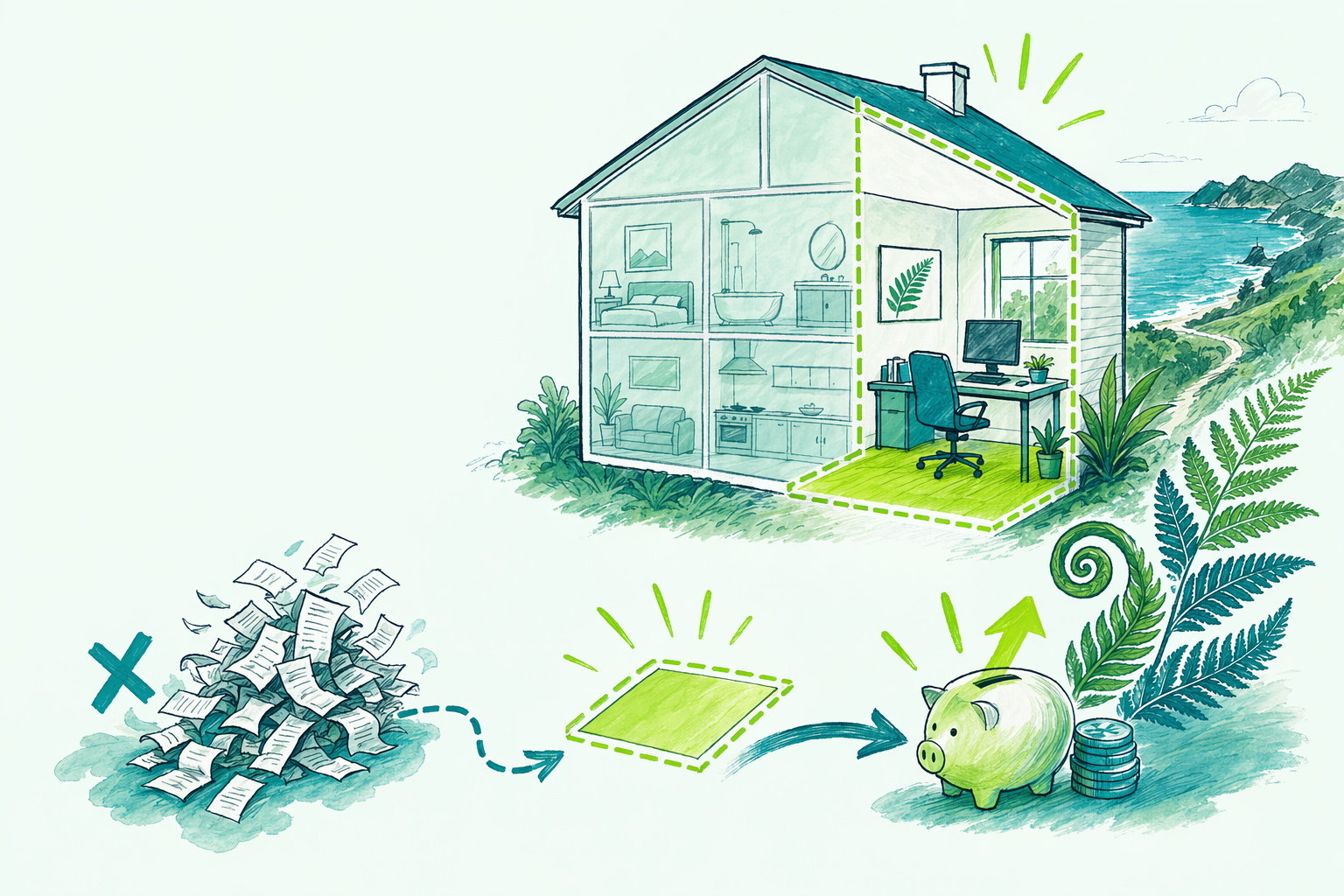
If you work from home, you can claim a share of your household costs against your business income. IRD's square-metre rate offers a shortcut that skips most of the receipts, and for many sole traders it is both simpler and surprisingly close to the actual-cost method.
Quick answer
The square-metre rate is a simplified way to claim home-office costs. Instead of working out the deductible share of every bill, you multiply the floor area of your work space by an IRD-published per-square-metre rate (updated each year), and add a portion of your premises costs such as mortgage interest, rent and rates.
It is designed to cut the paperwork. The per-square-metre figure already bundles the running costs like power, gas and internet, so you only separately apportion the big premises costs by floor area. For many home-based sole traders it gives a fair claim without keeping a shoebox of receipts.
The detail, in plain English
There are two ways to claim home-office expenses, and you choose the one that suits you:
- The actual-cost method. You add up the real household running costs (power, internet, insurance, rates, mortgage interest or rent) and claim the business-use percentage, usually based on the floor area your work space takes up. Accurate, but record-heavy.
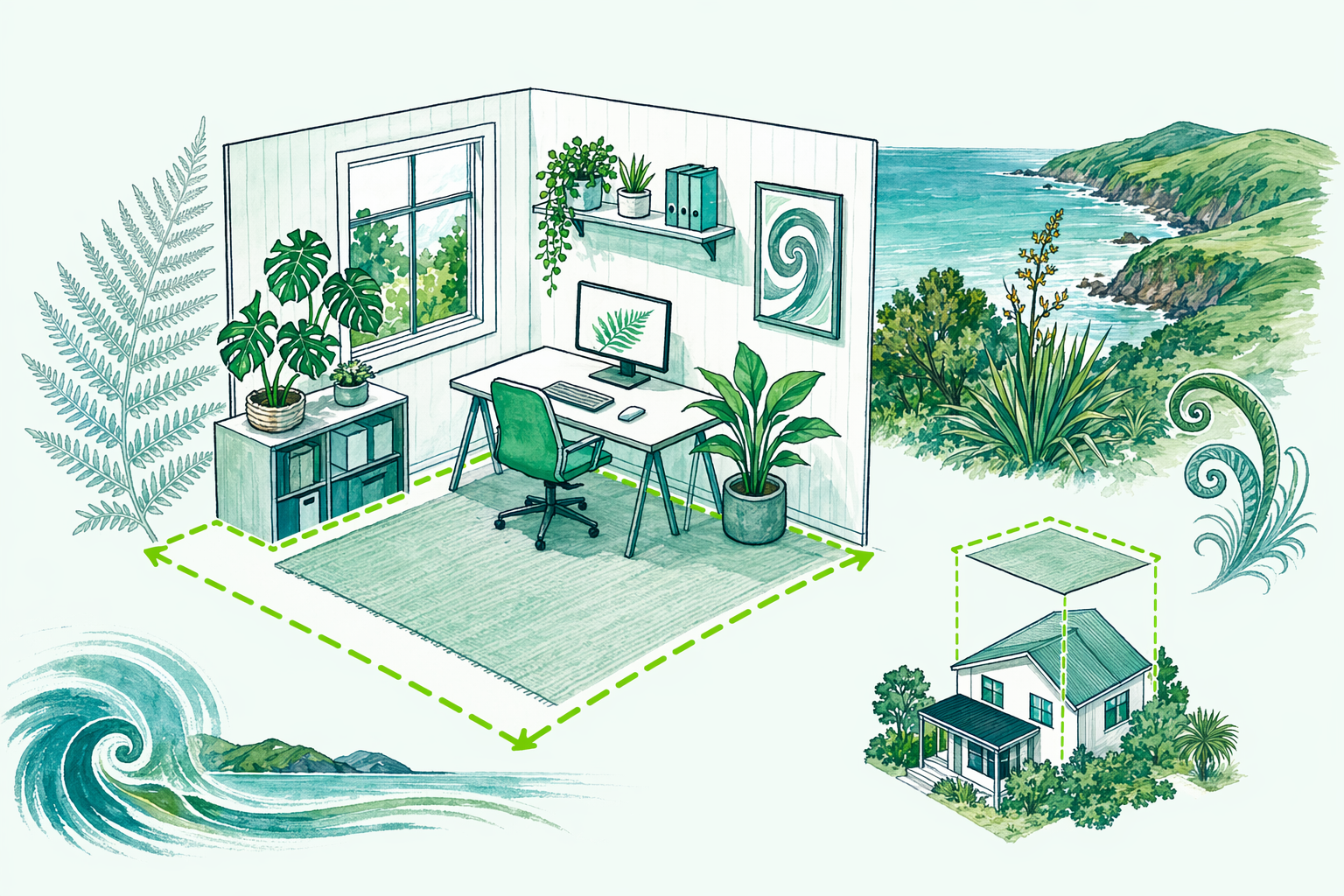
- The square-metre rate method. You measure your work-space area, multiply it by IRD's per-square-metre rate for the year (which covers the running costs), and separately add the same floor-area share of your premises costs (mortgage interest, rent, rates). Far less to track.
The square-metre rate splits costs into two buckets on purpose: the rate itself stands in for the variable running costs, while premises costs are still apportioned by area because they are large and specific to your home. You measure the work area honestly — a dedicated room or a clearly used portion of one — not the whole house.
You can generally switch methods year to year, so it is worth comparing once. If your running costs are unusually high, actual cost might win; for most people the square-metre rate is close and much faster.
Because IRD updates the per-square-metre figure each year, the rate you use should match the income year you are filing, not last year's number. It is a small detail that is easy to carry forward by mistake, and using a stale rate quietly under- or over-states the claim.
A simple example
Say your home office is 12 m² and IRD's square-metre rate for the year is around $53/m² (it changes annually):
| Component | Calculation | Claim |
|---|---|---|
| Running costs (via the rate) | 12 m² × ~$53 | about $636 |
| Premises share (interest, rates) if office is 8% of the floor area | 8% of premises costs | varies with your home |
So the $636 covers power, internet and the like without any receipt-sorting, and you only add the 8% floor-area share of your mortgage interest and rates on top. Compared with totting up twelve months of utility bills and apportioning each, the saving in effort is significant, and the result is usually in the same ballpark.
Common mistakes to avoid
- Double-claiming running costs. The rate already covers power, internet and similar — don't also claim them separately.
- Overstating the work area. Measure the space genuinely used for business, not the whole room or house.
- Forgetting to add premises costs. The rate does not include mortgage interest, rent or rates — those are added by floor-area share.
- Never comparing methods. If your actual running costs are high, the actual-cost method may give a bigger claim.
If you rent rather than own, remember that your rent is the premises cost to apportion by floor area, in place of mortgage interest. Renters sometimes claim only the square-metre running costs and forget the rent share entirely, which leaves a real chunk of the deduction unclaimed.
Where this fits in your return
The home-office claim is a business expense that reduces your net self-employed income on your IR3. Lower taxable income can in turn affect whether you reach the provisional-tax threshold, so it ties into provisional tax as well as your immediate bill.
It pairs naturally with the broader use-of-home expenses rules, which set out what counts as a deductible home cost in the first place.
How Fernway can help
We work out whether the square-metre rate or the actual-cost method gives you the better, defensible claim, measure the apportionment correctly, and fold it into your return. For most home-based sole traders the square-metre rate is the easy win, and we make sure you are not leaving the premises-cost portion on the table.
If you work from home and want to claim it properly, book a free 20-minute review.
This is general information only, not personalised tax advice. Your situation may differ, so confirm it with us or check ird.govt.nz.
In plain English: the square-metre rate lets you claim home-office running costs by area instead of by receipt, then add your floor-area share of mortgage interest, rent and rates — simpler than the actual-cost method and usually just as good.
This is general information, not personalised tax advice.See our full disclaimer.