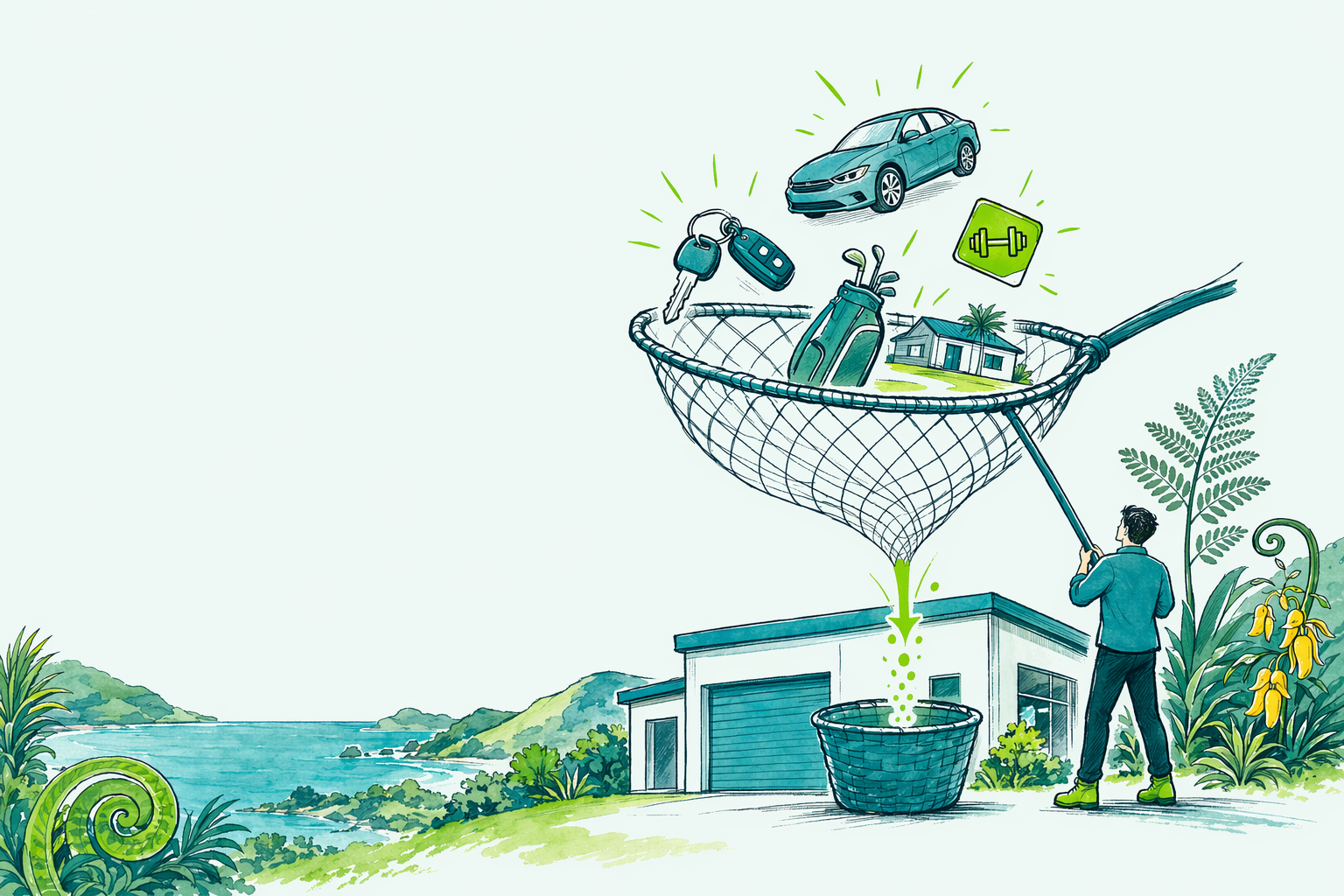
Fringe Benefit Tax is the tax your business pays when you give staff (or shareholder-employees) non-cash perks like a company car, a low-interest loan, or paid memberships. It catches a lot of NZ business owners off guard, especially the work-vehicle rules. Here is how FBT works and how to keep it under control.
What FBT is and who pays it
Fringe Benefit Tax is paid by the employer, not the employee. The idea is simple: if you reward someone with something other than cash, the tax system still wants its share, so the business pays tax on the value of the perk instead of the person paying it through their wages.
FBT applies when your company, partnership or trust provides a benefit to an employee, or to a shareholder-employee in a close company. That last point trips up a lot of small operators. If you run your business through a company and the company owns the car you drive after hours, you are very likely in FBT territory even though it feels like "your own" vehicle.
A sole trader generally does not pay FBT on their own use of a business asset, because there is no separate employer. Instead, a sole trader adjusts for private use directly in their IR3 (for example, by claiming only the business portion of vehicle costs). The moment you incorporate, the rules change, and that is one of the quieter tax consequences of forming a company.

Common taxable benefits
The benefits that most often create an FBT bill for small NZ businesses are:
- Motor vehicles available for private use — by far the most common, and the most misunderstood.
- Low-interest or interest-free loans to employees or shareholder-employees.
- Subsidised goods or services, such as discounted products sold to staff below cost.
- Free, subsidised or discounted memberships — gym, club or professional subscriptions paid by the business for private benefit.
- Contributions to certain insurance or superannuation outside the standard KiwiSaver and exempt arrangements.
Not everything counts. Genuine business tools, on-premises car parking in many cases, and minor or infrequent benefits under the de minimis thresholds can fall outside FBT. The de minimis rules let you provide small unclassified benefits up to set quarterly and annual limits before FBT applies, which is why the occasional staff gift usually does not trigger a return.
FBT filing frequency
FBT is usually returned on one of three cycles, and which one suits you depends on the size and consistency of your benefits:
- Quarterly — the default for most employers, with four returns a year aligned to the FBT quarters.
- Annual — available to some employers (broadly, smaller ones who meet the criteria), filed once a year.
- Income-year — an option mainly for close companies providing benefits to shareholder-employees, allowing FBT to be returned with the company's income tax return rather than on its own cycle.
The income-year option is genuinely useful for an owner-operated company with a single perk like one vehicle, because it folds the FBT into your normal end-of-year process instead of adding four separate filings. We help you pick the cycle that means the least admin for your situation.
Calculating the rate
FBT is calculated on the taxable value of the benefit, then taxed at an FBT rate. For vehicles, the taxable value is most often worked out using a percentage of the vehicle's cost price (or tax value), applied across the days it was available for private use.
The rate you apply matters. There are two broad approaches:
| Approach | How it works | Best for |
|---|---|---|
| Single flat rate | One high rate applied to all benefits | Simplicity, where most recipients are on the top tax rate |
| Attribution / alternate-rate | Benefits matched to each employee's marginal tax rate at year-end | Lowering FBT where staff are on lower rates |
The flat-rate method is simple but can overtax benefits given to people on lower incomes. The attribution method takes more work but can meaningfully reduce the bill, which is why a year-end wash-up calculation is often worth doing. Because FBT rates and the vehicle valuation percentages are set by IRD and can change, we always confirm the current figures before filing rather than relying on last year's numbers.

Keeping FBT under control
The practical ways to keep FBT manageable come down to design and records:
- Decide before you buy whether a vehicle will be available for private use. The answer drives the entire FBT outcome.
- Use the work-related vehicle exemption properly — correct vehicle type, real signage, a written restriction, and enforcement.
- Keep days-unavailable records so you are not paying FBT on days the vehicle genuinely could not be used privately.
- Consider an income-year return if you are a close company with one or two simple benefits.
- Review the cash-vs-perk question — sometimes a cash allowance the employee is taxed on through PAYE is cheaper overall than an FBT-bearing benefit.
FBT rewards planning. Set up correctly at the start of the year, it is a small annual exercise; set up loosely, it becomes an unwelcome adjustment when IRD reviews your vehicle arrangements.
This is general information, not personalised tax advice. Your situation may differ, so book a free review to discuss it with us or check ird.govt.nz.
In plain English: if your business hands out non-cash perks like a car or a cheap loan, FBT is the tax on that perk, and getting the vehicle rules right from day one is what keeps the bill small.
This is general information, not personalised tax advice.See our full disclaimer.