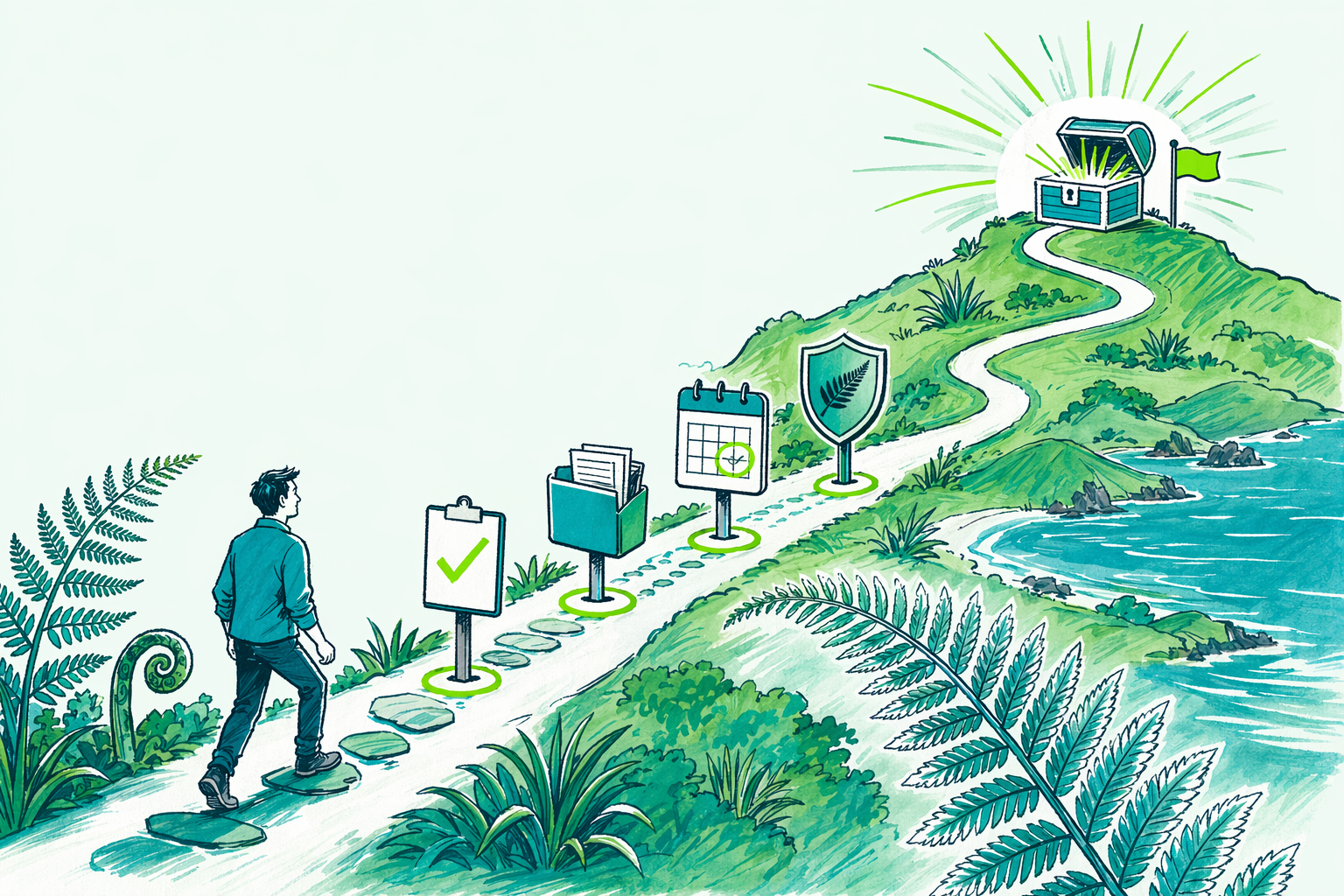
Your first year in business is the one where good habits, or bad ones, get set. Get the basics in place early and your first tax bill will be a number you saw coming, not a shock.
Quick answer
In your first year, the tax essentials are: have an IRD number, keep clean records from day one, register for GST if your turnover will cross $60,000, set money aside for income tax, and understand that provisional tax usually kicks in for your second year rather than your first. ACC levies will also arrive once you have filed.
The single most useful habit is putting aside a slice of every payment you receive, often around 20 to 30 percent depending on your income, into a separate account for tax and GST. That one move prevents most first-year cash-flow shocks.
The detail, in plain English
Here is the year-one checklist, in the order it tends to matter:
- IRD number and structure. Decide whether you are trading as a sole trader or company, and make sure you have an IRD number for it.
- Records from day one. Open a separate business bank account, keep every invoice and receipt, and ideally use accounting software so year-end is painless.
- GST. You must register once turnover passes $60,000 in any 12-month period, or when you expect to. Below that, registration is optional.
- Income tax. Your first-year profit is taxed when you file your first IR3 or IR4. There is no PAYE taking it out as you go, so you save for it yourself.
- Provisional tax. This usually starts in year two, once your first-year residual income tax is over $5,000. The classic trap is owing year-one tax and your first provisional instalment around the same time.
- ACC. ACC levies are invoiced after you file, based on your income, and are separate from your income tax.
The timing of these is what surprises people, especially the way year-one tax and year-two provisional tax can land close together.
A simple example
Sam starts a trade business and makes $70,000 profit in year one.
- Because turnover crossed $60,000, Sam registered for GST partway through the year and has been filing two-monthly returns.
- At year-end, Sam files an IR3 and has an income-tax bill on the $70,000 profit. Because that residual income tax is over $5,000, Sam now moves into provisional tax for year two.
- Soon after, an ACC invoice arrives, based on the filed income.
If Sam had set aside roughly a quarter of every payment along the way, the income tax, GST, and first provisional instalment are all funded and stress-free. If Sam had spent everything, that cluster of bills hits at once. Same business, very different first year, decided by one savings habit.
Common mistakes to avoid
- Not putting tax money aside. Without PAYE, nobody withholds your tax for you. Saving a fixed percentage of income is the fix.
- Mixing business and personal banking. One business account from the start saves hours at year-end and makes claims defensible.
- Registering for GST too late. Watch the rolling $60,000 line; crossing it without registering causes problems.
- Forgetting year-two provisional tax. The double-up of last year's tax plus the first provisional instalment is the classic first-year cash trap.
- Losing receipts. No record, no deduction. Photograph receipts as you go.
Where this fits in your return
Everything from year one lands on your first IR3 (sole trader) or IR4 (company). Your profit drives the income tax, the income tax drives whether you enter provisional tax, and your filed income drives the ACC invoice. GST sits alongside on its own cycle. Because each piece feeds the next, getting the records right in year one makes every return after it easier.
How Fernway can help
We help new businesses start clean: the right structure, GST decision, a simple records system, and a realistic figure to set aside for tax so nothing surprises you. We also flag the year-two provisional-tax double-up before it happens, so you are funded for it. Start right and you rarely have to clean up later.
This is general information only, not personalised tax advice. Your situation may differ, so book a free 20-minute review and we will set up your first year properly.
In plain English: get an IRD number, bank separately, watch the $60,000 GST line, set aside a quarter of your income for tax, and remember provisional tax usually bites in year two.
This is general information, not personalised tax advice.See our full disclaimer.