
New Zealand lets most registered businesses file GST monthly, two-monthly or six-monthly. Two-monthly is the common default; monthly suits regular refunds or tight tracking; six-monthly suits very small, steady operators. The right frequency is about cashflow rhythm, not tax owed.
The two options at a glance
Once you are GST-registered you choose how often you file. There are three taxable periods, and your turnover decides which are open to you.
- Monthly — available to anyone, required once turnover exceeds $24 million. Frequent returns, fastest refunds.
- Two-monthly — the common middle ground, available below the $24 million ceiling. Six returns a year.
- Six-monthly — available where turnover is under $500,000. Just two returns a year, lightest admin.
The 15% rate and the GST you owe are the same whichever you pick; only the timing and the admin change.
You also choose an accounting basis alongside the frequency. On the payments basis you account for GST when money actually moves, which helps cashflow because you are not paying GST on an invoice before the customer has paid you. On the invoice basis you account for GST when you raise or receive an invoice. Smaller businesses can often use the payments basis, and it pairs naturally with a shorter filing cycle.
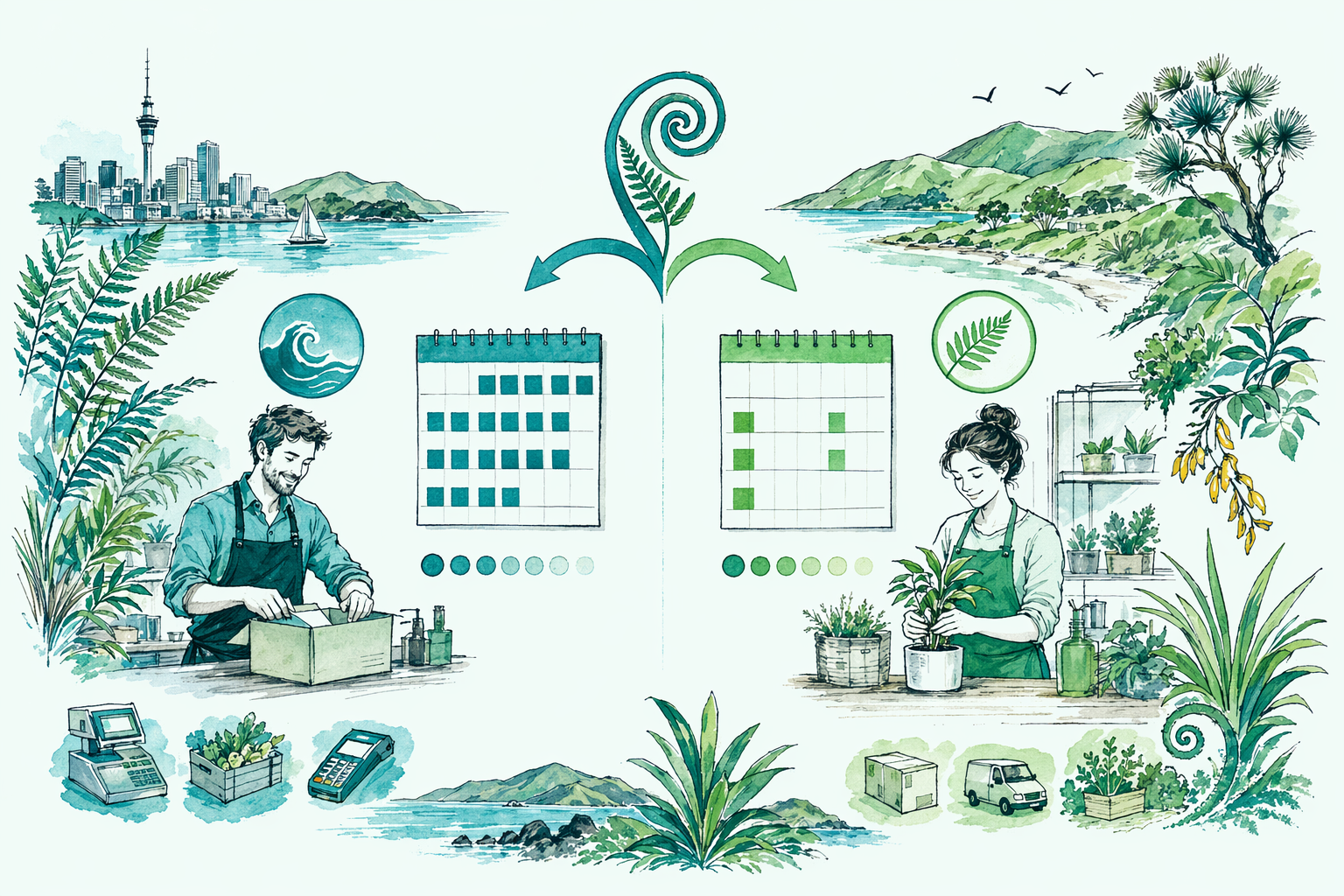
Tax treatment compared
| Frequency | Returns/year | Eligibility | Best for |
|---|---|---|---|
| Monthly | 12 | Any (required over $24m) | Regular GST refunds, tight tracking |
| Two-monthly | 6 | Under $24m | Most small and medium businesses |
| Six-monthly | 2 | Under $500k | Very small, steady, low-volume operators |
If you regularly receive GST refunds (common when you spend more on GST-bearing costs than you collect, such as in a growth or capital-heavy phase), filing monthly gets that cash back faster. If you usually pay GST to IRD, a longer period holds the money a little longer but means a larger payment when it falls due.
The right frequency often follows the direction of your GST. A business in a build-out or stock-heavy phase, spending more GST on costs than it collects on sales, sits in a refund position; filing monthly returns that cash sooner and improves working capital. A steady service business that mostly pays GST to IRD gains nothing from monthly filing and may prefer the lighter touch of two-monthly or even six-monthly.
Cost and cashflow
The cashflow trade is straightforward. More frequent filing smooths your GST in and out and gives a clearer running picture, but it asks for more discipline and more returns. Less frequent filing means fewer touchpoints, yet a bigger lump to find on payment day, and a longer wait for refunds.
Two-monthly is the popular default because it balances the two: returns often enough to stay on top of, payments small enough to manage. Six-monthly is tempting for the lightest admin, but only suits businesses that can comfortably set aside GST for half a year without spending it.
Whatever the frequency, the discipline is identical: the GST you collect is not your money. The trap of a longer cycle is that more GST accumulates in your account before it is due, which is easy to dip into and hard to find later. Banking GST to a separate account as you invoice removes that risk regardless of how often you file, and makes the longer cycles genuinely lighter rather than just delayed pain.
Risk and admin
The main risk of a long period is collecting GST and treating it as your own money, then struggling to pay when the six-monthly return lands. The main cost of a short period is the time spent filing twelve or six returns a year. With tidy bookkeeping in place, monthly and two-monthly are barely more work than six-monthly, and they catch errors sooner.
Whatever you choose, the payment dates are fixed, and late returns attract penalties and interest. The frequency should match a rhythm you can actually keep.
Which suits which owner
- Regular refunds or fast-growing — monthly returns your cash quickest.
- Typical small business — two-monthly is the sensible default.
- Tiny, steady, disciplined — six-monthly is the lightest, if you can hold the GST aside.
Talk it through with us
We will match your filing frequency to your cashflow, not just pick the default. If you tend to get refunds we will look at monthly; if cash is tight we will weigh up holding GST longer against the risk of a big payment. We can also set up your accounting so each return is close to a one-click job.
Book a free review and we will recommend the frequency that fits your cashflow.
This is general information only, not personalised tax advice. Confirm your situation with us or check ird.govt.nz.
In plain English: same GST either way; pick monthly for fast refunds, two-monthly as the everyday default, and six-monthly only if you are small, steady and disciplined.
This is general information, not personalised tax advice.See our full disclaimer.